
Already using AI for dev and test? Let's make it systematic
An AI-partnered testing service for teams already using AI for development and testing. AI works as your testing partner — not a replacement for testers — while your team builds the capability to run the loop yourselves. Designed to reach self-sufficiency within one year.
Book a free consultation ▶️ ✉️
Common AI Testing Challenges for Dev Teams
Your team is already using AI for development and testing — but it's not really systematic yet.
- AI-generated tests pile up, but no one's sure how much to trust them
- Coverage and quality vary depending on who's prompting the AI that day
- There's no shared method for feeding AI the right context (specs, domain knowledge, viewpoints)
- It's unclear where AI can run unsupervised and where a human must check
- You want AI to actually raise quality, not just produce more test artifacts
arQua:Intellity turns ad-hoc AI use into a repeatable, team-owned method.
What is arQua:Intellity?
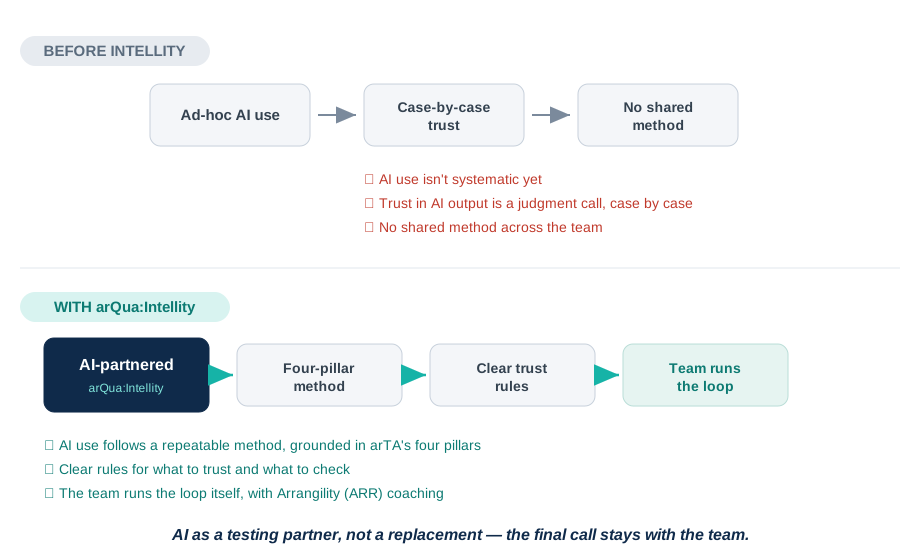
Our Methodology: The arTA Four-Pillar Model
Four pillars, grounded in ARR's own maturity model, arTA. An arTA diagnostic finds the weakest pillar for your team; Intellity closes that gap.
1. Foundation
Environment and test data readiness — the groundwork AI-assisted testing depends on.
2. Information fed to AI
Viewpoints, domain knowledge, and specs — what AI actually needs to produce useful output.
3. Verification mechanism
Checking AI's output repeatedly and systematically, not spot-checking on a whim.
4. Human-AI role division
Where AI can run unsupervised, and where a human must check — decided deliberately, not by default.
How AI changes testing
AI action | What it does |
Test planning | Drafts the test plan from scope, team, and risk |
Test design | Drafts test case candidates from specs |
Impact analysis | Scopes what needs testing from code changes |
Test code generation | Implements test code from natural language / test design |
Test data generation | Generates edge-case variations |
Failure analysis | Supports root-cause identification from error logs |
Test code refactoring | Proposes quality improvements |
Exploratory testing support | Charter creation, risk analysis, session log generation (the exploration itself stays human-led) |
The Playbook
ARR provides a Skill — a playbook package sourced from ARR's own loop-engineering methodology — delivered as a Claude Skill or a GitHub Copilot Agent Skill, depending on your tooling. It's how the four-pillar method gets embedded into your team's actual day-to-day workflow, not left as a slide.
Built for organisations like these
- Team makeup: dev/test teams already experimenting with AI tools
- Current state: AI-generated tests exist, but trust, coverage, and method are inconsistent
- Attitude to AI: already committed to using it — the gap is systematization, not adoption
- How you want to work: your team keeps doing the work; ARR builds the method and the Skill, then steps back
- The goal: the ability to keep quality up with AI, deciding what to trust, what to check, and where to draw the line — with the final "ship it" call always staying with the team
How the service is structured
Phase 1 — Foundation
1–2 months
ARR does the work Fixed package
Build the foundation, deliver the initial Skill.
Phase 2 — Expansion
3–6 months
ARR + client, pairing
Monthly support
Fit and align the Skill to your domain.
Phase 3 — Self-Sufficiency
3–6 months
Client's team only Monthly advisory
ARR acts as a sounding board for calibration only.
Spot consultation remains available after graduation.
Phase 1: Foundation
Phase 2: Expansion
Phase 3: Self-Sufficiency
Why choose arQua:Intellity?
vs. conventional test-automation support Their challenges: tool introduction only
- automated tests only
- external dependency continues.
vs. doing it in-house yourselves The challenges: AI use stays ad-hoc
- no shared method for what to trust
- hard to know if quality actually improved.
Our strengths
✓ A method grounded in arTA's four pillars, not gut feeling
✓ A concrete Skill (playbook), not just advice
✓ The final call always stays with your team
✓ Self-sufficient in a year
Expected outcomes
- The ability to keep quality up, working with AI — deciding what to trust, what to check, and where to draw the line.
- A repeatable method, not gut feeling — built on four pillars, diagnosed via arTA.
- A concrete playbook — a Skill your team actually uses, not a one-off deliverable.
- Appropriate role division — clear on where AI runs unsupervised and where a human must check.
- The final call stays with the team — ARR builds the capability, not the verdict.
A note on AI-generated tests
AI-generated tests need care:
- Unexpected test cases — tests that don't match the intent can be produced
- Tests built to pass — they don't verify what actually needs verifying
- Hollow tests — formally correct, but not a real check
Human review is essential. That's exactly what the four-pillar method and the verification mechanism (pillar 3) are for — deciding systematically, not case by case, when and how AI output gets checked.
Let's talk
Tell us about the challenges you're facing.
Contact Us ➡️ ✉️